RE-Play tickets · ticket-in / ticket-out (TiTo)
The ticket system Georgia was waiting for.
Machines print tickets; the store's counter station knows every one of them. A ticket is played again in any machine at that store, or redeemed at the counter for prizes. It is checked against the machine itself, never paid in cash, never paid twice, and it never expires.
The ticket flow
Print. Play again, or redeem. Keep the rest.
- The machine prints a ticket. The counter knows it exists the same second, because it reads what the machine printed, not what someone typed.
- Play it again in any machine at that store, or redeem at the counter for prizes: Lottery tickets and gift cards by default, up to eight ways the store chooses.
- Every ticket is checked against the machine's own meters. A fake, copied or altered ticket is refused. A ticket can never be paid twice.
- Keep the rest for later. Redeem part, keep the balance on a new ticket, on screen when there is no printer, or on a store card.
- Lost or damaged? A Supervisor replaces it; the old one stops working the same moment.
- Internet down? The counter and the machines keep going and catch up later.
01 · Audits
When someone asks, the answer is a download.
Operators answer to accountants, auditors and the State. Paper tickets answer to nobody.
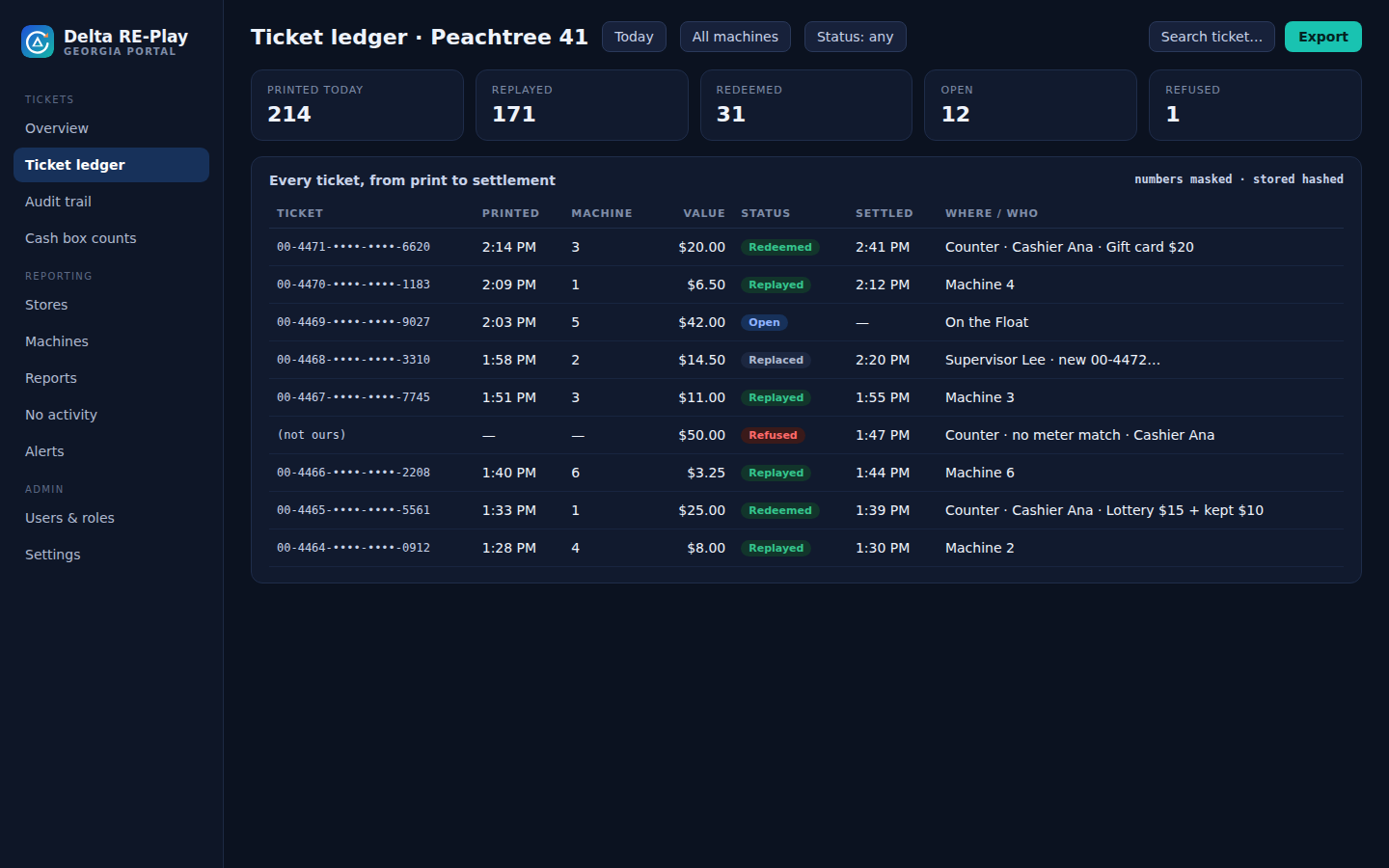
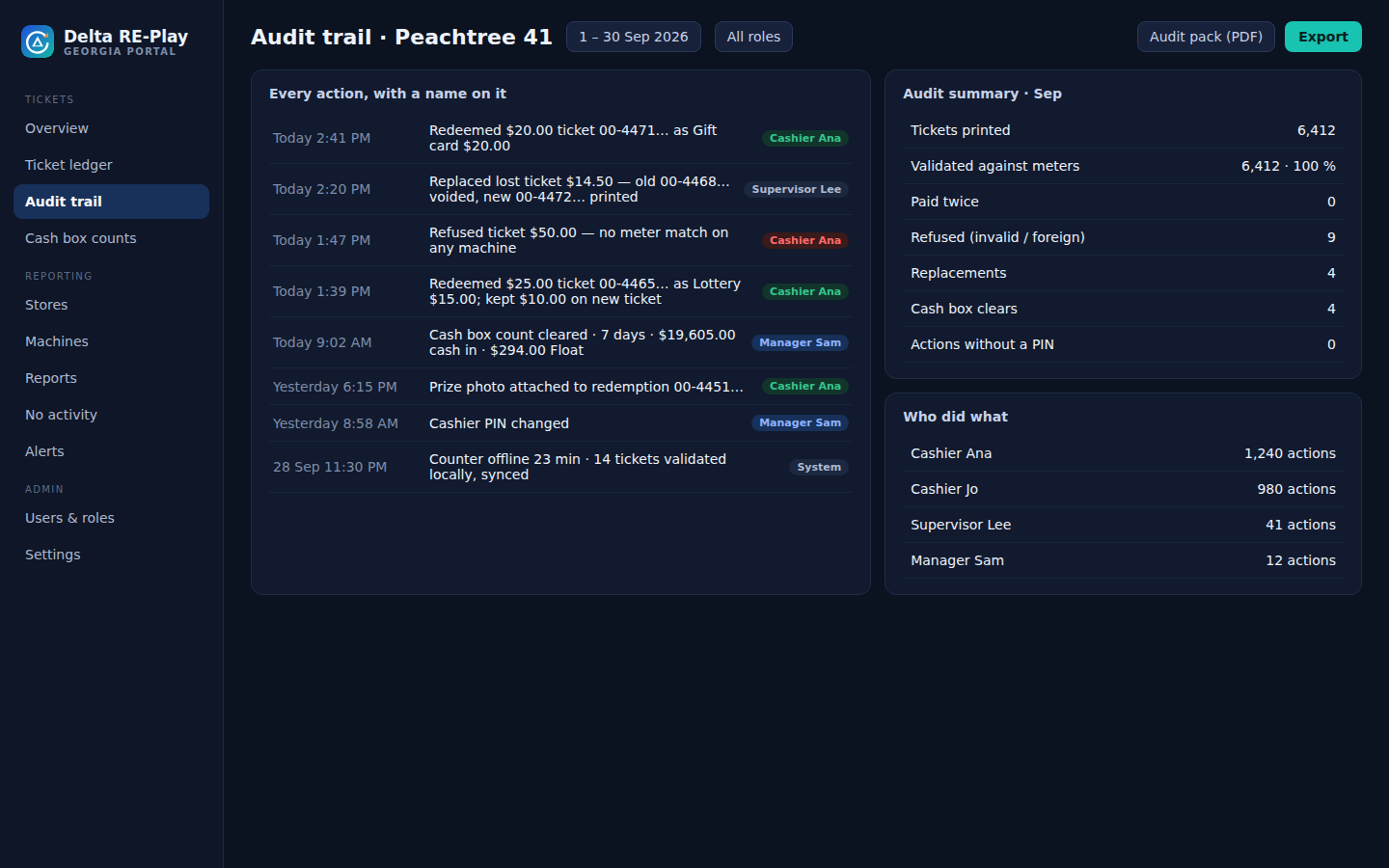
- Every ticket validated against the machine's meters, and the validation itself recorded. Not a sample. All of them.
- Every action with a name on it. Redemptions, replacements, refusals, cash box clears and PIN changes, each tagged with the role and PIN and the time.
- Paid twice: zero, provably. A paid ticket's status can never change. The ledger shows it.
- The audit pack. For any store and period: tickets printed, replayed, redeemed, open, refused, replaced; cash box clears with variances; who did what. One PDF, one spreadsheet.
- Fraud at the machine is watched too. Proprietary rules flag suspicious cash-out patterns, such as bill stringing, and alert the cashier on the counter and the owner in the portal.
- Ticket numbers are never stored in readable form, so the record is complete without being a target.
02 · Time
Hours a week, back to the store and the route.
- At the counter: scan, check, prize. No ticket log, no phone call to ask whether a ticket is real, no argument about a copy.
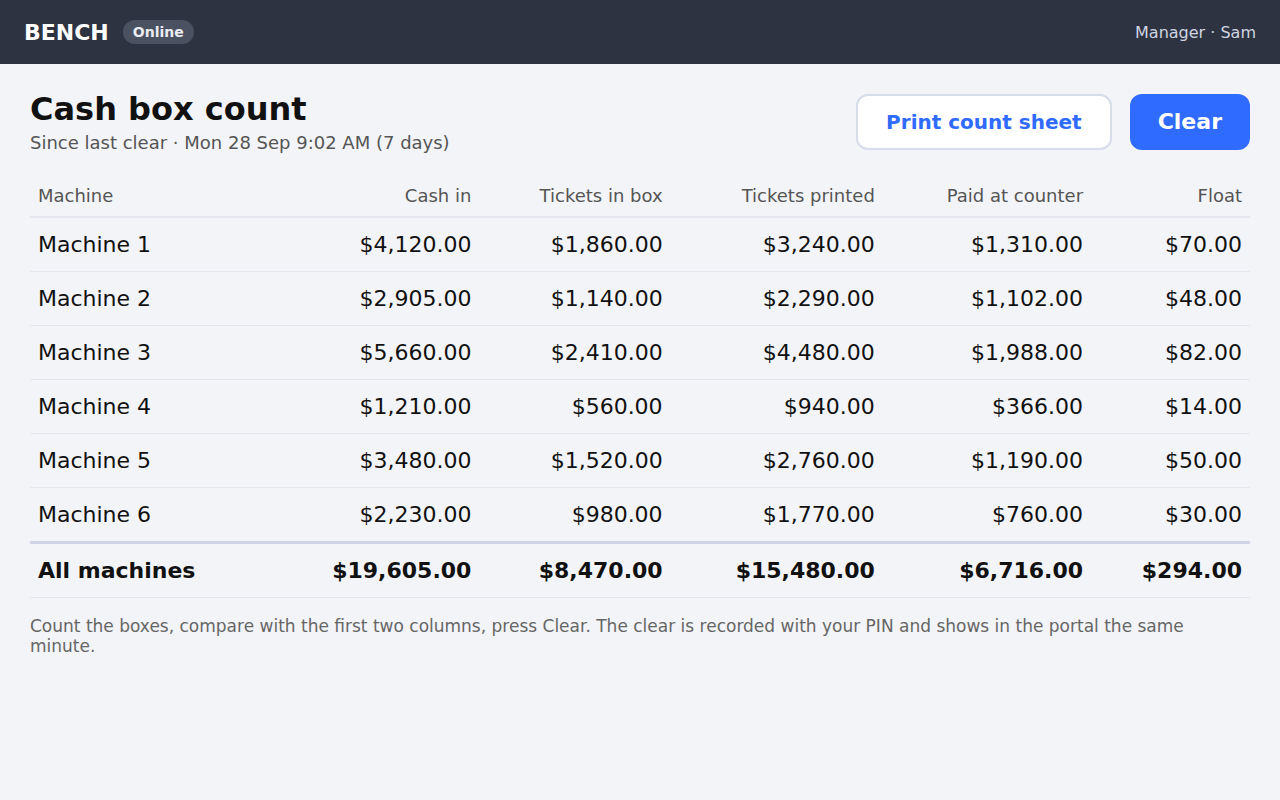
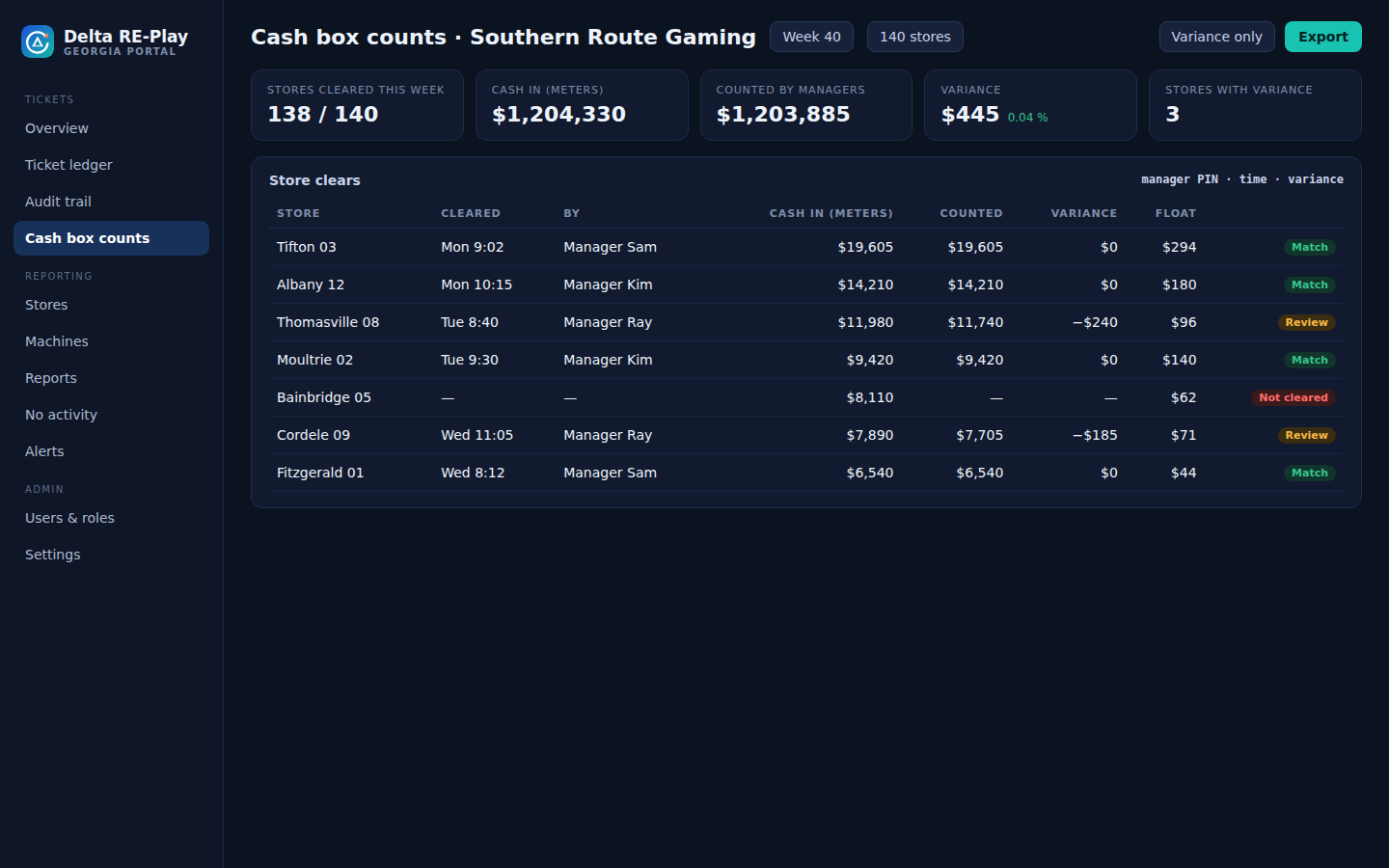
- For the manager: one banking visit a week. Count the boxes against the screen, compare, press Clear. The count sheet prints itself.
- For the area manager: no driving to read meters or collect ticket logs. Every store is on the phone at 7 a.m.
- For the back office: month-end is a download. Net Revenue is a column.
03 · Replay
Money that stays in the machines.
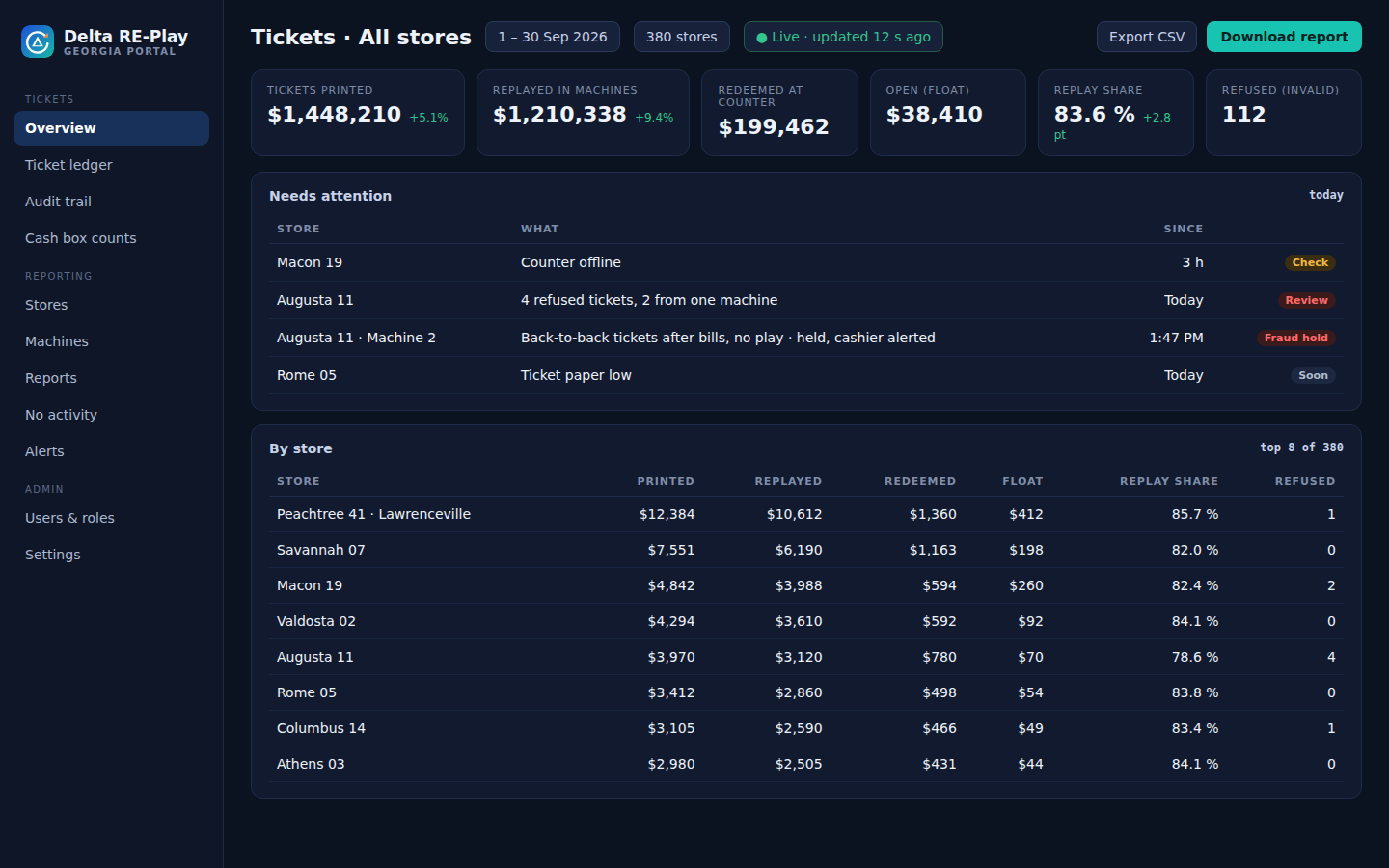
Every dollar a player keeps on a ticket is a dollar that can go back into play. RE-Play is designed around that, and it is where the revenue lift comes from: a leading route operator credited ticket adoption as a driver of an 8.3 % revenue increase in 2025, and a casino systems vendor measured play among tracked players up 21 % after a ticket enhancement.
- Keep the rest for later. Redeem part of a ticket and keep the balance on a new ticket or a store card. Nobody is forced to walk away from a few dollars, and nobody is forced to spend down to zero at the counter.
- Tickets never expire, so a balance is never lost and never forgotten.
- Any machine at the store takes the ticket back. A player moves machines without a trip to the counter.
- Store cards keep a regular's balance on something they carry, loaded only from prizes, never from cash.
- Replay share is a number. Tickets replayed as a share of tickets printed, per store, per machine, per day, so you can see what each store's counter habits do to the floor.
04 · Accurate reporting
From the machine's meters, not from memory.
- Tickets printed, replayed, redeemed, open. Straight from the machine, for any period and any store.
- Float you can see. Money sitting on open tickets, by store and by machine, so banking is computed on real numbers.
- Net Revenue in every report, ready for the books.
- Cash box variances across the company. What the meters say, what the manager counted, the difference, by store and by week.
- Exports as spreadsheet or PDF, per store or across the company.
Built for Georgia
The rules, and what RE-Play does about them.
Never cash
Georgia prohibits any form of cash redemption on a COAM. The counter has no cash path at all. Prizes go out as Lottery tickets, gift cards or merchandise, up to eight ways the store chooses.
1 July 2026
From that date the lawful Class B redemptions are replays, Lottery products and gift cards. RE-Play already pays prizes exactly those ways, with the audit trail each one needs, and keeps the rest on a ticket or a store card.
Collections stay with the Lottery
Net Revenue is a column in every report, by store, by machine and for any period. Collections stay with the Georgia Lottery; RE-Play does not perform collections.
| Card | Balance | Last used | Loaded from |
|---|---|---|---|
| •••• 4471 | $18.50 | Today 11:02 | Ticket 00-4471… |
| •••• 1180 | $6.00 | Yesterday | Ticket 00-3391… |
| •••• 7726 | $0.00 | 28 Sep | Ticket 00-2210… |
Never loaded from cash. Never cashed out. Spent only at this store with the customer's PIN.
Store cards
The store's own card, for the balance a regular keeps.
Optional NFC cards in the store's name. A prize balance is loaded onto a card and spent later at the same store with the customer's PIN. Never loaded from cash, never paid out as cash.
The 29 advantages
Why the whole industry moved to tickets.
Ticket-in / ticket-out was approved in Nevada in 2000. Within a decade it was on more than nine in ten US casino floors, it has been tested with thousands of venues and hundreds of thousands of machines, and route gaming is following. Here is what twenty-five years of operators learned, and what it means for a Georgia store.
01Lower cost, less labour
A two-cent ticket replaces a coin inventory
When casinos moved to tickets, a two-cent slip of thermal paper replaced the coin float sitting in every machine, and the staff who filled hoppers and counted buckets went with it. The same economics apply to a store with six machines: no change float, no hopper fills, no hand counts.
No more 24-hour count rooms
Before tickets, large floors ran a round-the-clock hard-count room: haul buckets, weigh coins on calibrated scales, wrap, re-impress. With tickets the machine's own meters are the count. Your weekly cash-box check takes minutes on the counter screen.
Fewer service calls and jams
Coin dust shorted boards and bent coins jammed hoppers, with downtime of an hour or more per jam. A ticket printer has one moving part, and we tell you when it is low on paper before a customer finds out.
Half a million dollars a year in cashier labour, at scale
Trade analysis of a 250-machine floor put the cashier and supervisor positions that tickets replace at close to $500,000 a year. A Georgia operator with 600 stores sees the same effect multiplied: one counter screen per store, not a person per shift.
Replacement cycles got faster, not slower
The largest operators in the world accelerated their machine replacement programmes specifically to take advantage of tickets, spending tens of millions over three years. They did it because the payback was obvious on the first floor.
More revenue, measurably
Operators who added tickets report lifts they can measure: a leading route operator credited ticket adoption as a driver of an 8.3 % revenue increase in its home state in 2025, and a casino systems vendor measured play among tracked players up 21 % after a ticket enhancement, with floor-wide play up 3 %. In a store, the mechanism is simple: balances stay on tickets and go back into the machines.
02Security and fraud prevention
Every ticket is validated against the machine's own meters
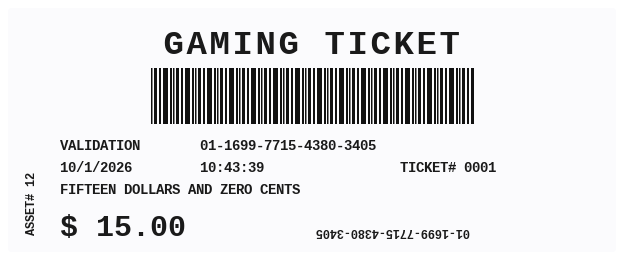
The industry standard ticket carries an 18-digit validation number in its barcode, generated on the machine from seeds the system supplies. Our counter checks that number against what the machine actually printed, so a copied, altered or invented ticket is refused on the spot.
A ticket can only be paid once
Regulators from Washington State to Colorado require a validation system to flag any ticket that was already redeemed, and to never change the status of a paid ticket. RE-Play applies the same rule in every store: paid is paid, and the record is permanent.
Fraud at the machine is watched too
A proprietary set of rules watches every machine's cash-outs. When the pattern looks like bill stringing or another validator trick, RE-Play flags that machine on the counter screen and in the portal, and the alert is kept in the record.
The record names the person
Every redemption, replacement and clear records which PIN did it and when. The famous insider frauds in the ticket era were caught precisely because the system kept the trail; the staff who tried photocopy scams only ever succeeded where the counter skipped validation.
Tickets stay inside the store that printed them
Cross-venue redemption is blocked in every regulated market because it would need linked real-time validation. Ours is simpler: a ticket is redeemed only at the store that printed it, so a ticket taken down the road is worth nothing.
Less cash exposed, less cash to steal
Prizes leave the store as Lottery tickets, gift cards or merchandise, never as cash from a drawer. There is no payout float for an employee to skim and no counterfeit note risk on the prize side.
Lost ticket, zero loss
A Supervisor can replace a damaged or lost ticket. The old number stops working the same second, so nobody can present the original later.
03Accuracy and accounting
The meter is the record
Ticket systems ride on the Slot Accounting System protocol, used by virtually every manufacturer and jurisdiction. The machine reports money in, money out, tickets in, tickets out and games played, with up to 18 digits per meter. Nothing is estimated from weighed coins.
Float you can see
Money sitting on unused tickets is a liability and an asset at once. The portal shows the Float for every store and every machine, so the week's banking is computed on real numbers.
Reconciliation in one screen
Since the last clear: cash in, tickets in the box, tickets printed, tickets paid at the counter, Float. Count the boxes, compare, press Clear. A manager who comes in once a week for banking is done before the coffee is cold.
Breakage becomes visible
In Nevada alone, more than $24 million a year sits on vouchers nobody redeems. RE-Play tickets never expire, so there is no silent breakage. Every open ticket is on the Float report until it is played or redeemed.
04Customer experience
Faster play, fewer interruptions
Players move from machine to machine with a ticket instead of waiting for an attendant or a hopper fill. Operators who converted reported higher play volume for exactly that reason.
Keep the rest for later
Redeem part of a ticket for a prize, keep the balance on a new ticket or a store card. Nobody is forced to spend down to zero or walk away from a few dollars.
Cleaner and simpler
No coin cups, no blackened hands, no tokens passed between dozens of people a day. Tickets were already the norm before 2020, and the hygiene case has only grown since.
A ticket is a receipt
Store name, date and time, amount in figures, machine number and a barcode. The customer holds proof, and so does the store.
05Built for Georgia's rules
Never cash, by construction
Georgia prohibits any form of cash redemption on a COAM. Our counter has no cash path at all: prizes go out as Lottery tickets, gift cards or merchandise, up to eight ways the store chooses. There is nothing to misconfigure.
Ready for the gift-card era
From 1 July 2026 the lawful Class B redemptions are replays, Lottery products and gift cards. The counter station already handles all three, with the audit trail each one needs.
Reads the port the State left for you
Every Class B machine in Georgia already speaks SAS 6.02 on its reporting ports. Port 1 belongs to the Lottery's central system; our reader listens on port 2 and never changes a thing on the machine.
Net Revenue, pre-computed
Net Revenue is a column in every report, by store, by machine and for any period, ready for the books.
06Proven at scale
More than 90 % of US casinos converted
Within a decade of the first Nevada approval in 2000, industry sources reported more than nine in ten US casinos had moved to tickets. Fewer than 150 coin-operated machines remain in the whole Las Vegas valley.
Route gaming is following
Illinois enabled tickets on every certified video gaming terminal statewide in July 2025, and the largest route operator reported 81 % of its locations fully ticket-enabled by year end. Distributed gaming is exactly Georgia's model.
Hundreds of thousands of printers in the field
A single model of ticket printer is installed in more than 750,000 machines worldwide. The hardware is mature, cheap and everywhere.
Proven with thousands of venues
Ticket-in / ticket-out has been tested by thousands of casinos, route operators and arcades and hundreds of thousands of machines over twenty-five years. RE-Play brings that proven model to Georgia's stores, one counter at a time.
Industry figures are drawn from public regulator filings, operator annual reports and trade press. They describe the ticket industry as a whole, not Delta RE-Play's own results.
Questions
Tickets, answered.
Can a ticket be redeemed for cash?
No. Georgia law prohibits cash redemption on a coin-operated amusement machine, and the counter has no cash path at all. Prizes go out as Lottery tickets, gift cards or merchandise, up to eight ways the store chooses.
Do tickets expire?
No. A ticket printed in a store is good at that store until it is played again or redeemed.
Can a ticket from one store be used at another?
No. Tickets are redeemed only at the store that printed them. That is what keeps a copied ticket worthless anywhere else.
What if a customer loses a ticket?
A Supervisor can replace it from the counter. The old ticket stops working the same moment; the new one carries the balance.
What if the store's internet goes down?
The counter and the machines keep working on the store's own network and catch up with the cloud when the connection returns.
Does the reader change anything on the machine?
No. The reader only reads the machine's meters, plus the ticket messages when the store turns the ticket system on. It never turns a game on or off, never touches credits, and never uses port 1, which belongs to the Lottery.
Can a customer keep part of a ticket?
Yes. Redeem part, keep the rest on a new ticket, on screen when there is no printer, or on a store card with the customer's PIN.
How does RE-Play increase replay?
Three ways. A player can redeem part of a ticket and keep the rest on a new ticket or a store card instead of spending down or walking out. Tickets never expire, so a balance is never lost. And any machine at the store takes the ticket back, so moving machines needs no trip to the counter. Replay share is reported per store and per machine.
What does an auditor get?
For any store and period: every ticket from print to settlement, every redemption, replacement and refusal with the role and PIN, cash box clears with variances, and the summary totals, as PDF and spreadsheet. Ticket numbers are masked on screen and stored hashed.
What about fraud at the machine itself?
A proprietary set of rules watches every machine's cash-outs. When the pattern looks like bill stringing or another validator trick, RE-Play flags that machine on the counter screen and in the portal, and the alert is kept in the record.